• A clarification … sort of.

    It is one thing to spend some time writing your thoughts down and having complete control over the way that those thoughts are presented. It is quite another thing to have an active conversation about those thoughts and try to speak to them extemporaneously without losing parts of your narrative. In episode 217 of “The Gay Mix” I posited a theory that I am calling “Cognitive Privilege” and had a discussion about it with my co-host Adam. I wanted to preserve my original thoughts about it here because I don’t know that I adequately made my points on the show.

    Cognitive Privilege: The Map That’s Missing Roads


    Something happened recently that I couldn’t stop thinking about. My co-host Adam — someone I care about — was openly struggling. Anxiety, fear, depression. Real suffering, the kind that doesn’t just go away because you decide it should. When that suffering was brought up on an episode of another podcast “Trigger Warning”, the response from one of the hosts was essentially: get over it. And if that wasn’t enough, they pivoted to money — implying that financial security is sufficient compensation for any psychological toll a situation takes on you, that a good paycheck makes your inner life irrelevant.

    My first reaction was anger. I’m not going to pretend otherwise. But anger, while valid, isn’t a diagnosis. And what I really wanted was a diagnosis. So bear with me as I stitch some random thoughts together in an attempt to understand why someone would be so casually cruel.


    The Bigger Pattern

    When I calmed down and sat with it, I started thinking about the broader culture we’re swimming in right now. We seem to care more about keeping a transgender girl off a junior high soccer field than we do about people being murdered in the streets by law enforcement. Every conversation is a battle. Every difference is a war. How did we get here?

    I watched a video from Coffeezilla on YouTube about deepfakes — specifically about how they’re being weaponized in scams. While the sophisticated deepfakes, the ones that are nearly indistinguishable from reality, are truly impressive; the real danger, he argued, lies in the barely passable ones. The fake videos of dogs rescuing cats. Cars sliding on ice into bystanders. Content that, once you’re told it’s fake, you can look back at and see the seams.

    What does flooding your feed with that kind of content actually do to a person? It builds a callous. You stop wanting to pay attention. You stop wanting to get concerned or emotionally invested in events because there’s always a chance it might be fake — and nobody wants to look like the person who got fooled. It doesn’t radicalize you. It just makes you not care. It spreads apathy.

    And then I thought about the daily barrage of bluster, contradiction, and noise coming from the current administration — statements that reverse themselves, outrages that pile on top of outrages, chaos that never resolves. That’s not just incompetence. That’s the same mechanism. It breeds the same apathy. Whether it’s deliberate or not almost doesn’t matter. The effect is the same: people disengage. People stop fighting for each other because the signal is too noisy to act on.


    The Diagnosis

    That’s when I came back to what was said about Adam.

    I didn’t want to keep being angry about it. I wanted to understand it — not to excuse it, but because I think understanding is actually the only thing that moves anything forward. If we keep going after each other for our differences without trying to understand where those differences come from, we just add to the noise. We become part of the problem we’re trying to name.

    So let me try to name it properly.

    There’s a concept in philosophy called epistemic injustice, coined by Miranda Fricker. It describes the way people’s experiences and knowledge get dismissed based on who they are — the sense that your suffering doesn’t count as information because of where it’s coming from. There’s also the well-documented empathy gap: the psychological reality that when you’re in a calm, unaffected state, you genuinely cannot predict or feel what someone in a distressed state experiences. It’s not just that you don’t want to — you actually lack the cognitive access.

    Both of those are real and relevant. But I want to go one level higher.

    I want to call it Cognitive Privilege.

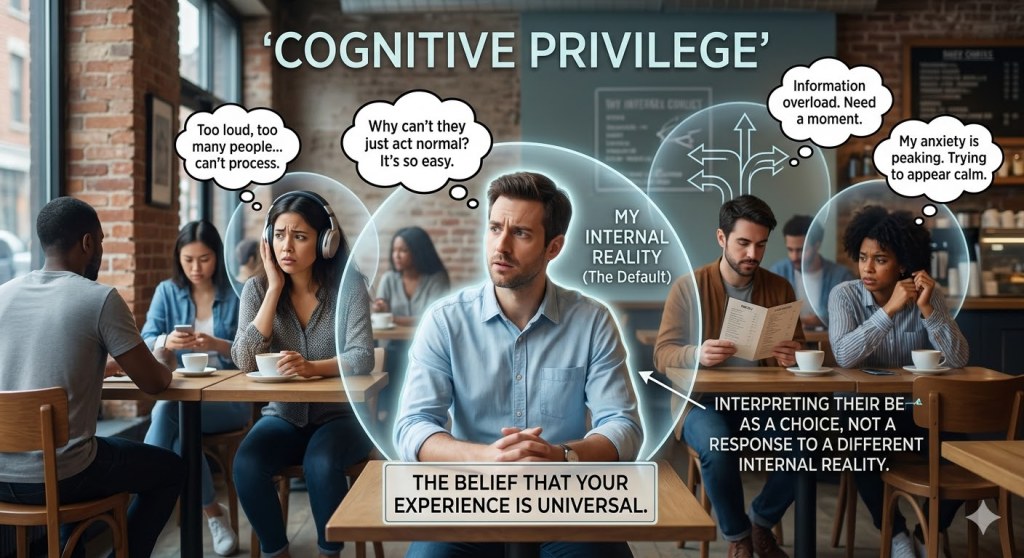
    Cognitive Privilege is the assumption that your internal experience of a situation is the default human experience — and therefore that anyone whose behavior differs from yours is making a choice rather than responding to a different reality.

    When someone tells a person with crippling anxiety to “just go to the doctor,” they’re not intentionally being cruel. They’re operating entirely from within their own cognitive map. And their map has no road that leads to going to the doctor is terrifying. They’ve never had to draw that road. They’ve never needed the workaround or developed the coping strategy or built up the explanation for why something the rest of the world treats as routine is, for them, genuinely not.

    That’s the structural part — and it’s why the privilege framing matters more than just calling it ignorance. Ignorance suggests you simply haven’t learned something yet. Privilege suggests something deeper: that your circumstances have never required you to learn it. And because you’ve never been asked to, you’ve built an entire framework for navigating the world that assumes your experience is everyone’s baseline.

    The host who told Adam to “get over it” probably can’t imagine what it costs someone with anxiety to sit in a waiting room, to be examined, to be vulnerable in a clinical setting. Not because they’re a bad person. Because their map doesn’t go there. And in a culture engineered to keep us at each other’s throats, to manufacture apathy and discourage the kind of sustained curiosity that would require us to actually listen to each other — well, that map stays incomplete for a lot of people for a very long time.


    Where Do We Go From Here?

    Here’s the honest question I had to sit with: Where am I cognitively privileged?

    What roads are missing from my map? What am I explaining away right now, or dismissing as a choice, because I haven’t lived the reality that would make it make sense?

    I don’t think you can drag someone out of Cognitive Privilege. I don’t think shame does it, and I don’t think outrage does it. But I do think people can find the edge of their own map — the moment where their framework stops accounting for someone else’s reality. And I think that’s where change actually begins.

    The antidote to manufactured apathy isn’t more outrage. It’s curiosity. Staying curious long enough to ask the question instead of giving the answer. Being willing to sit at the edge of your map and admit that somewhere beyond it, there’s territory you haven’t charted.

    That’s not naïve optimism. It’s not a solution. It’s a practice. And right now, it might be the most radical thing any of us can do.
  • Charleston’s Shattered Façade: The Denmark Vesey Plot and the Road to Civil War

    A comprehensive overview of the Denmark Vesey conspiracy, a meticulously planned slave revolt in Charleston, South Carolina, in 1822. They detail Vesey’s background as a free Black carpenter and literate church leader who, inspired by the Haitian Revolution and Old Testament liberation theology, organized a vast network of enslaved and free Black people. The sources explain the plot’s ambitious design—aiming to seize the city, kill enslavers, and escape to Haiti—and its eventual betrayal and suppression. Furthermore, the texts illuminate the profound and lasting aftermath of the conspiracy, including severe legislative responses like the Negro Seamen Act, the destruction of the African Methodist Episcopal Church, and a dramatic shift in Southern ideology from viewing slavery as a “necessary evil” to a “positive good,” ultimately contributing to the escalation of sectional tensions leading to the Civil War.

  • Engineered for Bondage: How Charleston Built America’s Wealthiest Slave Society

    Charleston rapidly developed into the most rigorous slave society in North America, largely influenced by the Barbadian plantation model. They detail the legal frameworks established, including the explicit sanctioning of slavery in the Fundamental Constitutions and the adoption of a draconian slave code mirroring Barbados’s. The texts highlight the economic engine of rice and indigo, driven by the specialized knowledge of enslaved West Africans and managed through the task system, which offered limited autonomy but ensured brutal efficiency. Furthermore, the sources emphasize Charleston’s role as the largest port of entry for enslaved Africans in North America and how external pressures, such as the threat of freedom from Spanish Florida and the failed experiment of a slavery-free Georgia, solidified South Carolina’s commitment to its slave-based economy.

  • A Primer of the American Civil War

    This episode examines the American Civil War not as an isolated event, but as the culmination of decades of escalating sectional conflict primarily driven by the institution of slavery. It traces the economic and social divergences between the industrial North and the agrarian, slave-dependent South, highlighting how westward expansion and political compromises repeatedly failed to resolve these tensions, instead fueling events like “Bleeding Kansas” and the Dred Scott decision. The text then details the course of the war from initial strategies to key battles like Antietam, Gettysburg, and Vicksburg, emphasizing how the conflict transformed into a struggle for emancipation following Lincoln’s Emancipation Proclamation. Finally, the report concludes by analyzing the Reconstruction era, acknowledging its revolutionary constitutional amendments but ultimately portraying it as a tragic failure due to a lack of federal will to protect the rights of freed people against violent opposition, leaving a legacy of racial inequality.

  • MIT Generative AI Study

    Why is GenAI missing in action at work? MIT NANDA’s 2025 report says 95% of projects deliver no ROI. We unpack the “GenAI Divide,” shadow AI habits, and what actually works: context-rich, learning systems, strategic partnerships, back-office automation, and agentic platforms that coordinate across the web—safely, reliably, at scale.

    This episode digs into MIT NANDA’s “State of AI in Business 2025” and its big plot twist: despite splashy investments, most companies aren’t getting results from GenAI. Why? Tools work fine for individuals, but enterprise rollouts often stumble—new tech doesn’t fit the workflow, can’t learn the company’s context, and never quite talks to existing systems.

    We translate the report’s insights into plain English. Think of general-purpose AI like a clever temp worker: great at quick tasks, not so great at your company’s unique processes. The report argues for a different path—learning-capable, customized systems that adapt over time, built through smart partnerships rather than massive in-house moonshots.

    You’ll hear where the early wins live (hello, back-office automation), how to measure value without fuzzy metrics, and what to do about the “shadow AI economy,” where employees quietly use their favorite tools anyway. Finally, we look ahead to “agentic” systems—AIs that coordinate actions across the internet, like well-trained assistants that can plan, execute, and improve.

    Whether you’re skeptical or just tired of slide-deck promises, this conversation offers a practical map for crossing the GenAI Divide and getting real ROI—without needing a PhD or a billion-dollar lab.

  • Biology of a Language Model: Circuit Tracing and Analysis

    Peek inside an AI’s ‘brain.’ Anthropic’s “circuit tracing” maps how language models think, step by step, from poetry planning to medical reasoning and saying no to harmful requests. We translate the science into plain English, spotlight wins, admit limits, and explore why this transparency matters for safer AI for everyone.

    This episode is a guided tour of how researchers are opening the black box of AI. Anthropic’s “circuit tracing” is like drawing a wiring diagram for a language model: it shows which parts light up, how information travels, and why the model lands on a particular answer—or refuses a harmful request.

    We keep it human-friendly. Instead of math, you’ll hear clear analogies: special “translators” that help one layer of the model talk to another, and map-like graphs that trace the flow of ideas. Then we visit real case studies on Claude 3.5 Haiku—multi-step reasoning, planning in poetry, multilingual patterns, even medical problem solving and built-in safety behaviors.

    No hype without honesty: the method still struggles with attention circuits, sometimes rebuilds signals imperfectly, and the maps can get complex fast. But understanding these inner circuits is a leap toward AI you can audit, improve, and trust. If you’re curious about how we make powerful models safer and more accountable, this is your on-ramp.

  • The Transformer: Architecture of Modern AI

    Meet the brain behind modern AI—Transformers, not the robots. In this episode, we unpack how self-attention lets models read context at once, replacing slow, forgetful RNNs. With plain language and crisp examples, you’ll learn how today’s chatbots think, why it matters, and where this tech is headed in daily life.

    Modern AI chat tools didn’t appear by magic—they run on a design called the Transformer. Think of older systems (RNNs) like reading a book one word at a time and trying to remember every sentence; it’s slow and easy to forget. Transformers take a group-photo approach: they look at all the words together and notice who’s related to whom.

    In clear, everyday language, we explain the Transformer’s secret sauce, “self-attention”—a way for the model to decide which words matter most in a sentence. Multi-head attention is like having several spotlights scanning the same scene from different angles, while positional encoding works like page numbers, keeping word order straight. A final pass (feed-forward networks) polishes the understanding.

    You’ll come away knowing why Transformers train faster, remember long-range connections better, and power the apps you already use—translation, summarization, search, and friendly chatbots. No math degree required; just curiosity. If you’ve ever wondered how AI “understands” language and why this breakthrough changed everything, this episode is your guided tour.