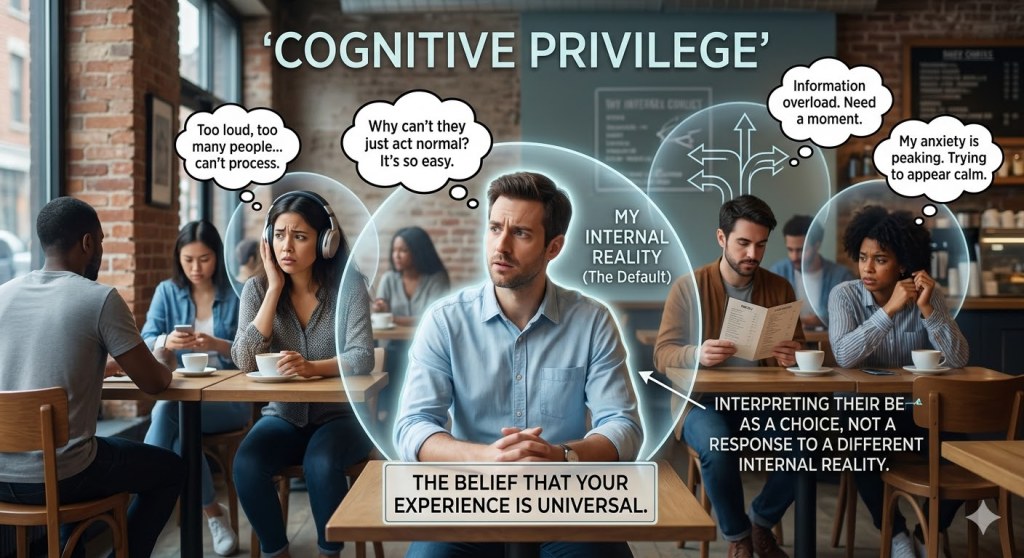
It is one thing to spend some time writing your thoughts down and having complete control over the way that those thoughts are presented. It is quite another thing to have an active conversation about those thoughts and try to speak to them extemporaneously without losing parts of your narrative. In episode 217 of “The Gay Mix” I posited a theory that I am calling “Cognitive Privilege” and had a discussion about it with my co-host Adam. I wanted to preserve my original thoughts about it here because I don’t know that I adequately made my points on the show.
Cognitive Privilege: The Map That’s Missing Roads
Something happened recently that I couldn’t stop thinking about. My co-host Adam — someone I care about — was openly struggling. Anxiety, fear, depression. Real suffering, the kind that doesn’t just go away because you decide it should. When that suffering was brought up on an episode of another podcast “Trigger Warning”, the response from one of the hosts was essentially: get over it. And if that wasn’t enough, they pivoted to money — implying that financial security is sufficient compensation for any psychological toll a situation takes on you, that a good paycheck makes your inner life irrelevant.
My first reaction was anger. I’m not going to pretend otherwise. But anger, while valid, isn’t a diagnosis. And what I really wanted was a diagnosis. So bear with me as I stitch some random thoughts together in an attempt to understand why someone would be so casually cruel.
The Bigger Pattern
When I calmed down and sat with it, I started thinking about the broader culture we’re swimming in right now. We seem to care more about keeping a transgender girl off a junior high soccer field than we do about people being murdered in the streets by law enforcement. Every conversation is a battle. Every difference is a war. How did we get here?
I watched a video from Coffeezilla on YouTube about deepfakes — specifically about how they’re being weaponized in scams. While the sophisticated deepfakes, the ones that are nearly indistinguishable from reality, are truly impressive; the real danger, he argued, lies in the barely passable ones. The fake videos of dogs rescuing cats. Cars sliding on ice into bystanders. Content that, once you’re told it’s fake, you can look back at and see the seams.
What does flooding your feed with that kind of content actually do to a person? It builds a callous. You stop wanting to pay attention. You stop wanting to get concerned or emotionally invested in events because there’s always a chance it might be fake — and nobody wants to look like the person who got fooled. It doesn’t radicalize you. It just makes you not care. It spreads apathy.
And then I thought about the daily barrage of bluster, contradiction, and noise coming from the current administration — statements that reverse themselves, outrages that pile on top of outrages, chaos that never resolves. That’s not just incompetence. That’s the same mechanism. It breeds the same apathy. Whether it’s deliberate or not almost doesn’t matter. The effect is the same: people disengage. People stop fighting for each other because the signal is too noisy to act on.
The Diagnosis
That’s when I came back to what was said about Adam.
I didn’t want to keep being angry about it. I wanted to understand it — not to excuse it, but because I think understanding is actually the only thing that moves anything forward. If we keep going after each other for our differences without trying to understand where those differences come from, we just add to the noise. We become part of the problem we’re trying to name.
So let me try to name it properly.
There’s a concept in philosophy called epistemic injustice, coined by Miranda Fricker. It describes the way people’s experiences and knowledge get dismissed based on who they are — the sense that your suffering doesn’t count as information because of where it’s coming from. There’s also the well-documented empathy gap: the psychological reality that when you’re in a calm, unaffected state, you genuinely cannot predict or feel what someone in a distressed state experiences. It’s not just that you don’t want to — you actually lack the cognitive access.
Both of those are real and relevant. But I want to go one level higher.
I want to call it Cognitive Privilege.
Cognitive Privilege is the assumption that your internal experience of a situation is the default human experience — and therefore that anyone whose behavior differs from yours is making a choice rather than responding to a different reality.
When someone tells a person with crippling anxiety to “just go to the doctor,” they’re not intentionally being cruel. They’re operating entirely from within their own cognitive map. And their map has no road that leads to going to the doctor is terrifying. They’ve never had to draw that road. They’ve never needed the workaround or developed the coping strategy or built up the explanation for why something the rest of the world treats as routine is, for them, genuinely not.
That’s the structural part — and it’s why the privilege framing matters more than just calling it ignorance. Ignorance suggests you simply haven’t learned something yet. Privilege suggests something deeper: that your circumstances have never required you to learn it. And because you’ve never been asked to, you’ve built an entire framework for navigating the world that assumes your experience is everyone’s baseline.
The host who told Adam to “get over it” probably can’t imagine what it costs someone with anxiety to sit in a waiting room, to be examined, to be vulnerable in a clinical setting. Not because they’re a bad person. Because their map doesn’t go there. And in a culture engineered to keep us at each other’s throats, to manufacture apathy and discourage the kind of sustained curiosity that would require us to actually listen to each other — well, that map stays incomplete for a lot of people for a very long time.
Where Do We Go From Here?
Here’s the honest question I had to sit with: Where am I cognitively privileged?
What roads are missing from my map? What am I explaining away right now, or dismissing as a choice, because I haven’t lived the reality that would make it make sense?
I don’t think you can drag someone out of Cognitive Privilege. I don’t think shame does it, and I don’t think outrage does it. But I do think people can find the edge of their own map — the moment where their framework stops accounting for someone else’s reality. And I think that’s where change actually begins.
The antidote to manufactured apathy isn’t more outrage. It’s curiosity. Staying curious long enough to ask the question instead of giving the answer. Being willing to sit at the edge of your map and admit that somewhere beyond it, there’s territory you haven’t charted.
That’s not naïve optimism. It’s not a solution. It’s a practice. And right now, it might be the most radical thing any of us can do.
 Rabbit Hole
Leave a comment